CVPR 2024 AgVision Workshop

VisTA-SR: Improving the Accuracy and Resolution of Low-Cost Thermal Imaging Cameras for Agriculture

1 Department of Biological and Agricultural Engineering, UC Davis
2 Department of Plant Sciences, UC Davis
3 Department of Viticulture and Enology, UC Davis
VisTA-SR Framework Overview

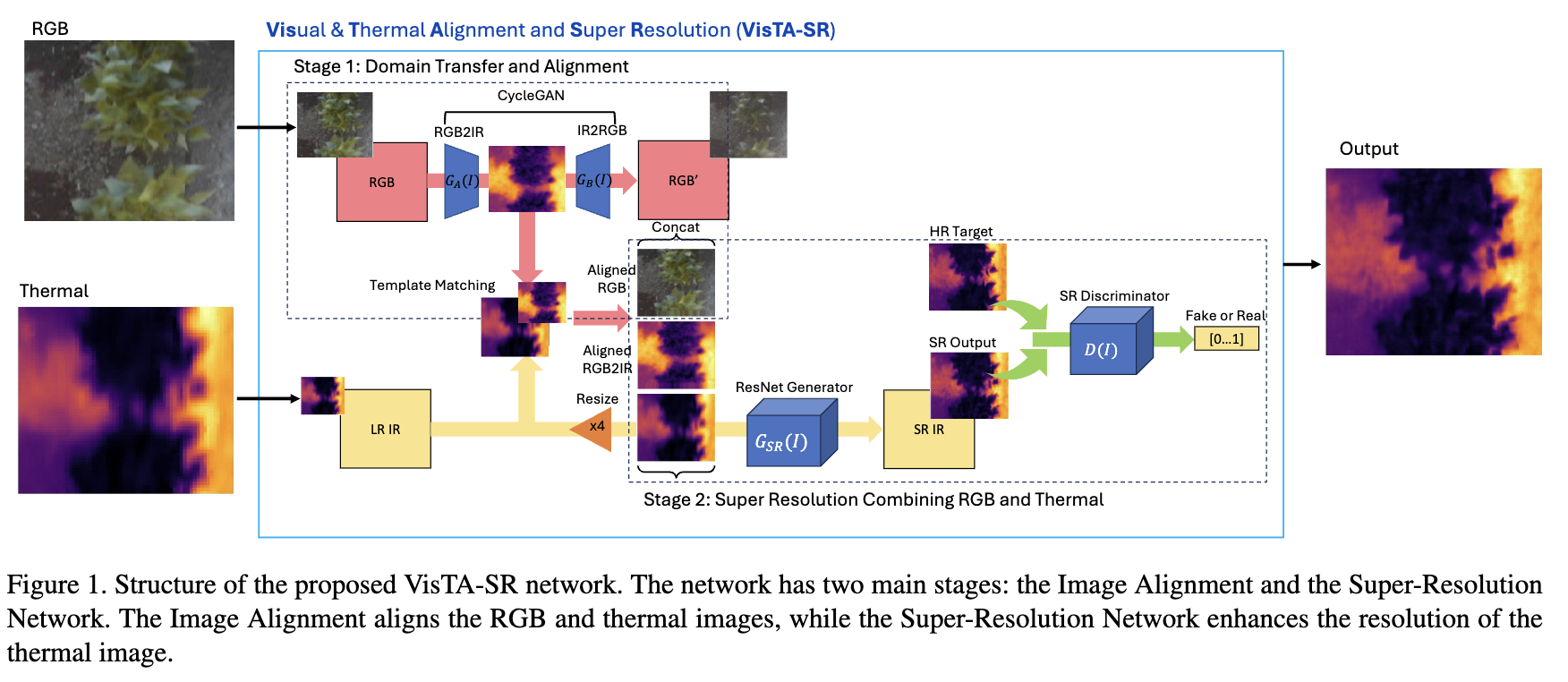
Figure 1. Overview of the VisTA-SR framework: Spatial alignment of low-resolution thermal and high-resolution RGB image pairs followed by guided super-resolution and radiometric calibration.

Abstract

Thermal imaging provides key physiological metrics such as canopy temperature, stomatal conductance, and crop water stress index. However, high-resolution radiometric thermal cameras remain cost-prohibitive for large-scale agricultural monitoring. Consumer-grade thermal sensors present an affordable alternative, but suffer from low spatial resolution and thermal measurement noise.

We present VisTA-SR, a multimodal deep learning framework designed to enhance both the spatial resolution and temperature measurement accuracy of low-cost thermal cameras. By leveraging high-resolution RGB imagery as a structural guide, VisTA-SR aligns multimodal image pairs and super-resolves low-resolution thermal features. The framework integrates a radiometric calibration pipeline to correct sensor temperature drift. Evaluated on field data collected from garbanzo bean plots, VisTA-SR enables organ-level canopy temperature extraction at a fraction of the cost of industrial thermal imaging systems.
Method Overview

Key Technical Components

  • Multimodal Spatial Alignment: Corrects parallax and field-of-view differences between low-resolution thermal and high-resolution RGB image sensors under operational field conditions.
  • RGB-Guided Super-Resolution: Employs a dual-stage deep neural network that uses high-frequency structural features from RGB images to guide thermal upsampling and sharpen canopy boundaries.
  • Radiometric Calibration: Incorporates empirical reference targets and environmental temperature compensation to improve absolute temperature accuracy.
  • Organ-Level Phenotyping: Enables separation of leaf canopy, stem, and soil temperatures in field plots to support crop water stress evaluations.

Code & Dataset

The code repository and field benchmark dataset are available at the following locations:

Citation

@inproceedings{yun2024vista, title={VisTA-SR: Improving the Accuracy and Resolution of Low-Cost Thermal Imaging Cameras for Agriculture}, author={Yun, Heesup and Lo, Sassoum and Diepenbrock, Christine H. and Bailey, Brian N. and Earles, J. Mason}, booktitle={Proceedings of the IEEE/CVF Conference on Computer Vision and Pattern Recognition (CVPR) Workshops}, pages={5470--5479}, year={2024} }