Journal Paper: Multimodal Optical Biosensing and 3D-CNN Fusion for Basil Water Stress Phenotyping Project
I am pleased to announce the publication of our latest paper in Agronomy, titled “Multimodal Optical Biosensing and 3D-CNN Fusion for Phenotyping Physiological Responses of Basil Under Water Deficit Stress”.
This work was a collaborative effort with Kyung Hee University, Republic of Korea.
- Title: Multimodal Optical Biosensing and 3D-CNN Fusion for Phenotyping Physiological Responses of Basil Under Water Deficit Stress
- Authors: Yu-Jin Jeon, Hyoung Seok Kim, Taek Sung Lee, Soo Hyun Park, Heesup Yun, and Dae-Hyun Jung
- Journal: Agronomy (MDPI), 2026, 16(1), 55
- Publication Date: December 24, 2025
- DOI: 10.3390/agronomy16010055
Research Summary
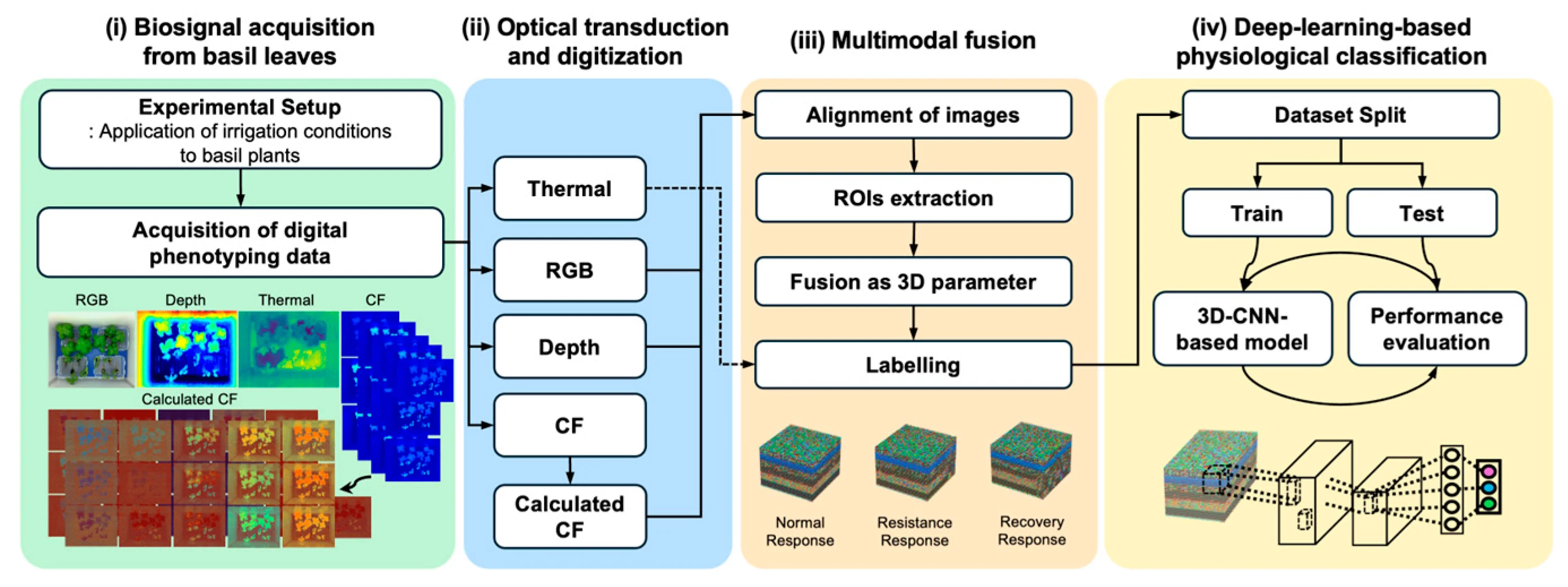
This paper presents a non-destructive framework for monitoring water-deficit responses in basil using deep learning. We developed a fusion model combining RGB, Depth, and Chlorophyll Fluorescence (CF) imaging with a 3D Convolutional Neural Network (3D-CNN).
Key findings include:
- The 3D-CNN model achieved a remarkable 96.9% classification accuracy in water stress classification tasks (Normal, Resistance, and Recovery).
- This approach effectively captures spatial and temporal-spectral features, outperforming traditional 2D-CNN and machine learning models.
- The results demonstrate the scalability of multi-modal information merging for precision irrigation and agricultural monitoring.
My opinion:
- The study suggests that adopting more advanced fusion techniques, such as Transformers, could further enhance the precision of physiological response phenotyping.
My Contribution:
- Provided editorial feedback and proofread the manuscript to ensure technical clarity and academic rigor.
BibTeX Citation
Academic Attribution:
@Article{agronomy16010055,
AUTHOR = {Jeon, Yu-Jin and Kim, Hyoung Seok and Lee, Taek Sung and Park, Soo Hyun and Yun, Heesup and Jung, Dae-Hyun},
TITLE = {Multimodal Optical Biosensing and 3D-CNN Fusion for Phenotyping Physiological Responses of Basil Under Water Deficit Stress},
JOURNAL = {Agronomy},
VOLUME = {16},
YEAR = {2026},
NUMBER = {1},
ARTICLE-NUMBER = {55},
URL = {https://www.mdpi.com/2073-4395/16/1/55},
ISSN = {2073-4395},
ABSTRACT = {Water availability critically affects basil (Ocimum basilicum L.) growth and physiological performance, making the early and precise monitoring of water-deficit responses essential for precision irrigation. However, conventional visual or biochemical methods are destructive and unsuitable for real-time assessment. This study presents a multimodal optical biosensing and 3D convolutional neural network (3D-CNN) fusion framework for phenotyping physiological responses of basil under water-deficit stress. RGB, depth, and chlorophyll fluorescence (CF) imaging were integrated to capture complementary morphological and photosynthetic information. Through the fusion of 130 optical parameter layers, the 3D-CNN model learned spatial and temporal–spectral features associated with resistance and recovery dynamics, achieving 96.9% classification accuracy—outperforming both 2D-CNN and traditional machine-learning classifiers. Feature-space visualization using t-SNE confirmed that the learned latent representations reflected biologically meaningful stress–recovery trajectories rather than superficial visual differences. This multimodal fusion framework provides a scalable and interpretable approach for the real-time, non-destructive monitoring of crop water stress, establishing a foundation for adaptive irrigation control and intelligent environmental management in precision agriculture.},
DOI = {10.3390/agronomy16010055}
}